The third annual update of the Myanmar earthquake map is now available, covering 100 years of epicentres with data through December 2025. Notably, this edition highlights the devastating earthquakes from March 2025. You can explore this map and other resources on the MIMU Earthquake Emergency Preparedness and Response page.
News
The latest Emergency and Resilience Plan (ERP) 2026–2028 from the Food and Agriculture Organization of the United Nations (FAO) outlines the integrated approach to protecting livelihoods, restoring food production and strengthening resilience. Combining time-critical agricultural assistance with climate-resilient practices, natural resource management, anticipatory action and strengthened evidence and coordination, the ERP bridges humanitarian response and medium-term recovery.
Be sure to review the latest report from the Market Analysis Unit (MAU). The Market Price Report (MPR) for November 2025 covers data from 41 townships across 9 states/regions in Myanmar. Data are collected from three vendors per product per market at the end of each month.
The Market Analysis Unit is an independent project that provides donors, humanitarian responders, development practitioners and private sector actors in Myanmar with data and analysis to better understand the impacts of market developments, conflict and other crises on household purchasing power, supply chains, financial services, and labour markets.
Nearly 80% of youth reported awareness of serious climate issues, with floods, heatwaves, heavy rainfall, and droughts being the most commonly identified hazards. More than 70% of youth believe that climate conditions will either worsen or remain poor. Nearly two in five young people reported awareness of local climate or environmental initiatives.
Escalating climate and environmental pressures are shaping how young people across Myanmar experience daily life, deepening uncertainty in a country already strained by conflict and economic crisis. This fourth and final report in UNDP’s Myanmar Youth Series, examines how youth perceive climate and environmental risks and where pathways for action emerge. Drawing on the voices of more than 7,000 young people nationwide, the findings reveal widespread awareness of climate challenges, but uneven concern and limited opportunities to respond.
Explore the report in English language and summary in Myanmar language.
In 2025 (data as of 30 November 2025), there are 286,574 downloads of MIMU-developed products from our website. Of these, the following are among the top 10 most downloaded.

Administrative Maps of Kachin, Shan, and Rakhine States
MIMU-developed administrative maps have become essential reference and operational maps for humanitarian and development actors in Myanmar. As the states with the high organisational presence according to the latest round of the MIMU HDP Nexus 5W (75 in Kachin, 87 in Shan, and 70 in Rakhine), the maps of these states were the three most downloaded MIMU products in 2025. These can be found on the MIMU’s GIS Resources page.
Map of Probable Damaged Buildings in Mandalay and Sagaing Areas
As a testament to MIMU’s support in the aftermath of the earthquake, this map ranks fourth among the most downloaded files in 2025. It was developed with technical support from the Asian Disaster Preparedness Center (ADPC), building on UNOSAT’s preliminary analyses and satellite imagery from THEOS-2 and Maxar. To improve accuracy, MIMU also incorporated field validation collected by MIMU staff on the ground.
Map of Earthquake Impact Along the Yangon–Mandalay Expressway
To support transportation and logistics for recovery efforts, MIMU developed a map showing potentially damaged sections along the Yangon–Nay Pyi Taw–Mandalay Expressway.
Exercise Files from Excel Training
Based on popular demand, six Myanmar-language technical training courses have been converted into self-paced courses with exercise materials, available to download through the MIMU website.
Map of Myanmar States/Regions and Townships
This map was produced in November 2023 and serves as a reference map of townships, and includes a useful Pcodes list of townships.
Map of Earthquakes in Mandalay and Sagaing Areas
This was the first map that MIMU produced in the aftermath of the 28 March 2025 earthquake, developed within a few hours of the event.
Myanmar Administrative Maps in English and Myanmar
These two large-format maps (6 ft × 3 ft) are among MIMU’s most well-known products, used for reference, operational planning, and strategic decision-making. Available on the MIMU’s GIS Resources page.
In support of the recently released Humanitarian Needs and Response Plan (HNRP) 2026 for Myanmar, clusters have also been releasing their strategy documents.
- Early Recovery Cluster aims to restore basic services and livelihoods, prioritising debris removal, recycling and waste management for over 1.25 million people in need.
- Education Cluster will target 1.1 million people (32% of those in need): 98% children, including 141,000 children with disabilities.
- Food Security Cluster’s Emergency food assistance will target 1.3 million people in areas highly affected by conflict and disasters, prioritizing improved physical and economic access to food for the most vulnerable households.
- Health Cluster: In 2026, 9.3 million people in Myanmar will need support with basic health care, amid conflict/disaster impacts and 1,815 recorded attacks on health care since February 2021.
- Nutrition Cluster will deliver life-saving and preventive services to about 677,375 crisis-affected people, within an estimated 2.6 million who need essential nutrition support to prevent and manage acute malnutrition.
- Shelter/NFI/CCCM Cluster aims to assist 3.4 million crisis-affected people with life-saving shelter, essential NFIs, and site management support amid escalating conflict and disaster-driven displacement.
- WASH Cluster plans to reach 2.4 million of the 8.9 million people in need, requiring US$119.9 million to deliver risk-informed, standards-based WASH services that adapt to shocks such as earthquakes, AWD/cholera outbreaks, and floods.

The dedicated page for Gender-Based Violence (GBV) Area of Responsibility (AoR) in Myanmar has been updated with more resources, including an updated dashboard on AoR’s earthquake response.
For this round, 10 organizations have provided 40 new Assessments/Publications as of 19 November 2025, bringing the total to 2,673 records from 205 organizations. These are available through the MIMU Assessments & Publications Tracking Webpage.
The updated MIMU Assessment Tracking Overview Dashboard can be seen through the link: https://themimu.info/assessment-dashboard.
Thanks to all agencies for your active participation in this exercise.
You are more than welcome to provide updated info of your planned and ongoing assessment at any time online through the submission page (You will need an account and if do not have one, please contact us). Please consult the guideline if you need any assistance or feel free to reach out to us.
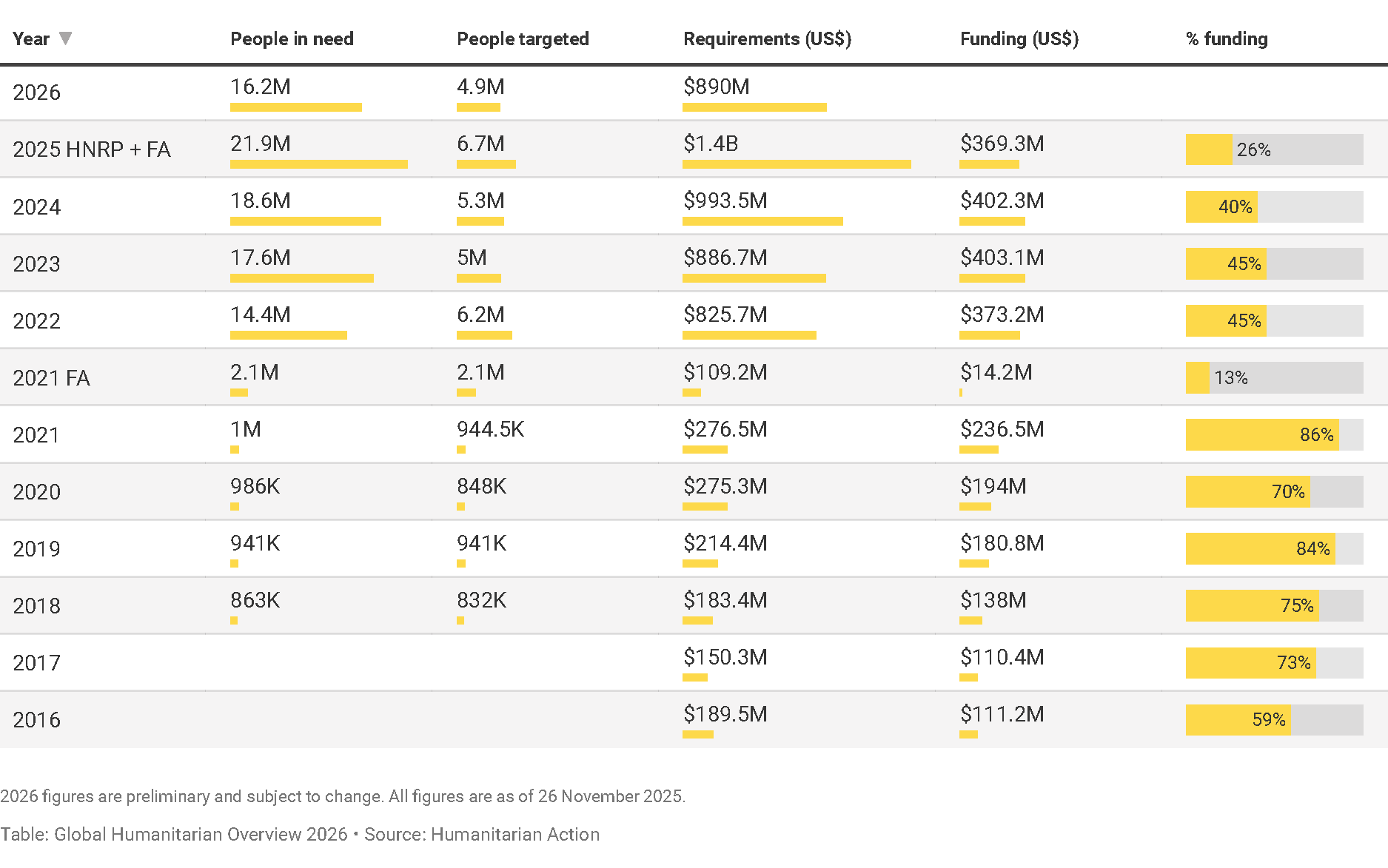
The recently launched 2026 Myanmar Humanitarian Needs and Response Plan identifies critical priorities to address Myanmar's deepening humanitarian crisis.
Key highlights include
- 16.2 million people in need
- 4.9 million people targeted for humanitarian assistance
- US$890 million required to address critical needs
Cluster Strategy Related to HNRP
Economic conditions in Myanmar remain severely constrained, shaped by the lingering impacts of the March 2025 earthquake, ongoing conflict, subdued domestic demand, labor shortages, and persistent power outages. The recovery is fragile and uneven, with businesses and households continuing to face significant challenges.
Review the latest Myanmar economic monitor report from the World Bank. The report, titled “Myanmar Economic Monitor : Surviving, Not Thriving - Special focus on Myanmar’s Agrifood Industry Resilience and Adaptability”.
Only 45% of earthquake-affected firms have returned to pre-earthquake activity levels, with manufacturing and agriculture facing the slowest recovery due to physical damage, high reconstruction costs, and limited access to finance.
Household impact: The MSPS surveys show the earthquake affected 16% of households nationwide and nearly 60% near Mandalay, Sagaing, and Naypyitaw. Consumption fell by 2%, and poverty rose sharply.
Repairs & livelihoods: Only half of affected households have begun repairs. Loss of homes, assets, and jobs has deepened vulnerability; informal work has increased in urban areas.
Looking ahead: A 3% rebound is projected in FY2026/27, driven by reconstruction and targeted support, but financing shortfalls, labor shortages, weak demand, and structural constraints may slow recovery.
- ‹ previous
- 2 of 19
- next ›